Logo

Catholic and feminist: You got a problem with that?

Tuesday, January 6, 2009
Catholic and feminist: You got a problem with that?
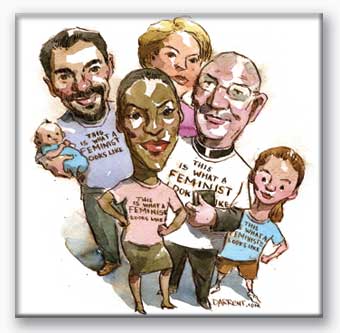
Catholics ought to be loud and proud in the fight for women’s rights, argues a young feminist.

I wasn’t burning my training bras or hating men (they weren’t yet on my radar screen, anyway), but my feminism was ardently liberal and a huge reason I struggled with my faith.

Over the past few years, I have become more immersed in the Catholic world, and I’ve learned that I’m not the only one who struggles with faith and feminism. There are, of course, many who reject Catholicism outright because of the lack of women in top leadership, and a few who courageously fight to change the 2,000-year-old patriarchal institution.

On the other hand, it seems that many vocal Catholics are saying, “I’m not a feminist.” For whatever reason—it’s too radical, man-hating, or pro-choice—a number of Catholic men and women deny or qualify feminism. By doing so, though, they are only hurting themselves and their sisters.

It’s time more Catholics, both men and women, opened up the conversation between these two points of view. I will always hope the church will treat women in its ranks more equally, but in opening this conversation, I also have come to see a positive relationship between Catholicism and an active feminism that aims to protect the rights of the most vulnerable. Because women, and consequently their children, still suffer the effects of poverty and other injustices more than men do, Catholics must fight for them.

Realizing this has allowed me to be as proud of being a Catholic as I am of being a feminist. For other Catholics, I hope reflecting on faith and feminism moves them to declare themselves proud to be feminists as well.

Apopular Catholic alternative to feminism these days is “new feminism,” Pope John Paul II’s idea that women should embrace their “feminine genius,” or capacity for physical and spiritual motherhood. New feminists defend the dignity of women who choose to stay home, a personal decision I admire, though I would not agree that all women are blessed with feminine genius simply based on gender.

My mother stayed home for nearly 20 years raising my brother and me, but she taught me that feminism extended beyond home life. Feminism is activism—protecting the rights of women in both the public and private sphere. As a feminist I raise women’s issues with friends and at work; I lobby for legislation and vote (knowing women have had this right for less than 90 years and currently hold only 16 percent of congressional seats); and I give to organizations that support women in the United States and abroad.

My greatest qualm with “new feminism” is that I think it is more about a personal decision than activism. Moreover it is not concerned with the “least of these” among us but instead with families that can afford to live off one income while one parent stays home.

An authentically Catholic feminism is not only about vocation or glass ceilings. It is about simply keeping the floor under women, respecting their dignity and rights as people.

Third World feminists challenge Western and predominantly white feminists to struggle not only with issues of gender but also those of race, culture, and class. This is essentially what Catholic feminism does. Catholic teachings on solidarity demand that we listen to the marginalized and oppressed. In this sense Catholic social teaching and feminism go hand-in-hand on many issues.

Catholics, for instance, take a feminist stance on workers’ rights. Issues like fair pay, family leave, and flexible scheduling allow women more equitable treatment at work, but they also promote the good of the family. This isn’t just about the do-it-all mom in upper management; it’s about families struggling to maintain a middle-class lifestyle with two salaries and single moms earning the minimum wage.

We need to fight for the likes of Lilly M. Ledbetter, who sued Goodyear when she learned she was paid less than the lowest-paid man at her level. Women, who still earn 78 cents for every $1 earned by men, were handed a setback when the Supreme Court ruled last May that complaints must be filed within 180 days of the first discriminatory pay decision, even if the employee only learns of the discrimination much later.

The ruling also violated Catholic principles about the rights of workers, which include the just wage. The decision was hailed for protecting businesses, but from a Catholic perspective the economy must serve people, not the other way around.

Catholics are also feminists in our preferential option for the poor and concern for human rights such as health care, education, food, shelter, and protection from violence. Feminists must take Catholic social teaching seriously because women are especially hurt by poverty and the violation of their rights and dignity as human beings.

The U.S. Census Bureau found that the poverty rate of female-headed households was about 30 percent in 2005. Catholic feminists should support an adequate social safety net to protect the health and welfare of women and their children in this country.

Cardinal Renato Martino, the president of the Pontifical Council for Justice and Peace, recently pointed out that this is an issue worldwide as well: “It must not be forgotten that today extreme poverty has, above all, the face of women and children, especially in Africa,” he said last August.

The United Nations’ Millennium Development Goals (MDGs), aimed at reducing global poverty, identify gender equality (goal #3) and women’s access to employment, education, and health care as economic problems. For those who live on less than a dollar a day—the majority of whom are female—putting food on the table is a women’s issue.

Catholic feminists can act in solidarity with these women by supporting development efforts. Microloans for women, co-ops, and education programs have become key strategies for development because it is now widely accepted that economies grow where women’s conditions improve.

Still, women seeking a better life elsewhere are now half of all migrants worldwide, according to Caritas Internationalis, the Catholic Church’s umbrella humanitarian organization. Caritas focuses on women and migration because women are more vulnerable to exploitation and trafficking than their male counterparts.

Violence affects female migrants, women in war-torn countries, rape victims shunned in their cultures, as well as American women facing domestic abuse and sexual assault. Preventing this violence, in my opinion, is one of the most important causes for feminists. Because each man and woman is made in God’s image, Catholics are called to confront and prevent violence against women wherever it may be.

But what about the elephant in the living room: How are human dignity and respect for the lives of women and unborn children best upheld in the hotly debated area that feminists call “reproductive rights”?

Certainly Catholics and feminists take a variety of stances on the many issues covered by the term reproductive rights: abortion, birth control, sex education, condoms in AIDS-ravaged countries, incest, and rape and its use as a tool of war.

There is some good news on the prickliest of these issues, abortion: A study by Catholics in Alliance for the Common Good found that from 1982 to 2000 benefits for pregnant women, including employment policies, economic assistance, and child care, reduced abortions. These are all women’s issues Catholic feminists can fight for while protecting the unborn.

Being Catholic and feminist isn’t easy, but the important part is that Catholics bring their faith to bear on their feminism, ask tough questions, and act on their beliefs.

When I got angry at my junior high friend for distancing herself from feminism, I’m not sure I could define feminism. In fact, it remains a flexible term covering a large and diverse movement.

But the statement “I’m not a feminist” still irks me. Women and men must look critically at the world, take into account their values, and figure out what it means for them to support the dignity and rights of their mothers, sisters, and daughters.

If Catholics did so, I think everyone would be as proud as I am to say, “I am a feminist.”

And the Survey Says...
 AgreeDisagreeOther
I am a feminist:
34%
44%
22%
Pope John Paul II’s view of the “feminine genius” is more appealing to me than secular feminism.
26%
32%
42%
The Catholic Church has a good record on women’s rights.
21%
67%
12%
The abortion issue prevents me from calling myself a feminist.
18%
66%
16%
While poverty is an important issue, it shouldn’t be the main focus of feminists.
48%
44%
8%
Women have achieved equal rights and don’t need to fight for them anymore.
5%
92%
3%
Results are based on survey responses from 101 U.S. Catholic readers and website visitors. Advance copies of Sounding Board are mailed to a sample of U.S. Catholic subscribers. A representative selection of their comments follow in Feedback.
The top causes for Catholic feminists should be:
Poverty reduction.
16%
Reproductive rights.
15%
Health care.
15%
Pro-life.
14%
Violence prevention.
12%
Workplace equality.
8%
Upholding the value of motherhood.
6%
Women’s ordination.
3%
Other.
11%

Megan Sweas is an assistant editor at U.S. Catholic. This article appeared in the January 2009 (Volume 74, Number 1; pages 23-25) issue of U.S. Catholic.

Comments (20)

Comment viewing options

Select your preferred way to display the comments and click "Save settings" to activate your changes.

I do not call myself a

I do not call myself a feminist, but on this issue, I must speak. Jesus never outright said a woman cannot be ordained. That he chose 12-men may very well have been because he knew human nature. At that time, people did not listen to women because their hearts were hardened. Similarly, a law allowing divorce was written in the Old Testiment because man's heart was hardened, but then Jesus came down and said it was incorrect. A law allowing a certificate of divorce is written in the Old Testament, but it was an incorrect, sinful law written by man according to Jesus. Similarly, Jesus did not write a law barring women from ministry. Check out Titus 2:3, where it says "the older women likewise, that they may be reverent in behavior, not slanderous, not given to much wine, teachers of good things-". Teachers of good things...isn't that what a priest is? And when Jesus rose, the first people he appeared to were women! It was Mary Magdalene he told to spread word that he had risen. Does that sound like he didn't want women preaching or spreading his word? It was man who outright banned women from ministry, not Jesus. If he did not want women teaching, he would have said so. I don't see any evidence that Jesus intended to bar women from being ordained. Any law barring women from anything was created by men after Jesus ascended into heaven. And when you look at the law regarding divorce, well, let's face it. Humans are not always correct, are they?

Viva la Papist Feminists!

I hope to see this discussion expanded upon in the future. Looks to me like many in the "feminine genius" camp (a concept I agree with in its literal meaning) cite the idea as a way to end further discussion of women's role, duties, rights, risks in the world outside the home, and also of the realities of single women (who are not women Religious). Pretending everybody's a) married and b) can afford to be a one-income family just isn't going to work.

I'm in the middle of an e-fight as we speak over the whole Prejean and gay marriage business. I'm arguing that setting up Prejean as a hero makes it impossible for many Christians, and especially many Christian women, to have any place in that fight. It's as if, to fight for traditional marriage, we must accept immoral behavior on Prejean-the-hero's part. It's as if the controversies over sexism, objectification, dehumanization, increasingly bizarre bodies created by "cosmetic" surgeries, eating disorders, near-nudity in front of "judges", etc. etc. don't even exist; they're not issues for (most?) Christian men, therefore Christian women don't have the right to bring them up?

I truly feel that, right now, I have no home -- that, in addition to going against the mainstream culture because of ubiquitious sin, exploitation and immorality, I also don't fit in with most Catholics, for the same, albeit, slightly less frequent, reasons. John Paul II identified the hatred and exploitation of women as an integral aspect of Original Sin, but I've never met a single Catholic man outide of the priesthood who gets it. It's great (as in downright incredible!) that Catholic clergy are really starting to understand the particulars of the oppression of women, but when are the Catholic laity going to get a clue (not to mention Protestants)?

Feminism and Faith

I always find it a bit ironic to hear men speak about feminism. I believe it to be an intellectual exercise. I often think the word Feminism was and is a word created to keep at arms length the truth of the blatant sexism that exists not only within our Church but in our world. Sexism, racism,ageism, etc are all considered to be evils within any system and are named as such. They cause division. I would suggest that one read the deeper content of the article and know that as women, we struggle to continue to live out our faith, within a Church that continues to rationalize its treatment of women through what I call "bible beatings." I have committed my life to the Church, not because of its blatant sexism, but because of the belief that God is present in each of us, and that our Church, this human institution, at some level does value each person. Unfortunately, the implementation of this truth has not yet been realized in current Church practices but I believe was present in the time of Christ. Until the argument/s end about who can do what because of gender, we will continue to miss out on the greater truth, that we each exist because we are a mere breath of a loving God.
I do admit that I long for a day when our Church will simply acknowledge that the current treatment of women is not upheld by the Gospels, but by tradition(gone astray!)...and that traditions can change! In the meantime, I will continue to live out my faith in a broken church, and I cling to my belief that with my Beloved, gender is an arbitrary thing we humans use for division.

Dear Sister Sharon to

Dear Sister Sharon to believe sincerely what you so clearly and eloquently expressed and to have the spiritual strength to continue in your way of life is simply marverlious, simply heroic.

Catholic and feminist

Praying the Liturgy of the Hours (printed in 1976) almost every morning, I cringe when the reading seems to indicate that "men" are forgiven, that Christ came to save all "men."

My shorter, traveling version of the Liturgy from the Benedictines (1997) has more inclusive language and is virtually cringe-free, is fully open to all persons.

When reading the bishop's guidelines on forming our consciences before voting, my lectio divina habits led me to this focus: "troubled pregnant women." How can we show concern for the unborn without showing concern for the women carrying them? For all women? Labels -- such as pro-life, pro-choice, feminist, anti-feminist -- get in the way of our following Christ. Our language can limit our faith.

Collaboration

Excellent essay, Megan. I think you've covered all the pressing topics, which are part of a larger picture -- namely how to live holiness in a fallen world. That said, the reason I don't use "feminism" to describe my work of twenty years (as a writer on this topic) is 1. one has to constantly define it to make clear what exactly is meant by the term; and 2. I've come to the conclusion that any "-ism" devolves into a zero-sum game. Women often see the need to protect themselves -- even at the expense of babies or men. Only when we realise that solidarity has to bring everyone forward will it be effective.

Now for the other essential point: activism, I find it's short-sighted to think that one can change things in this way, in fact such a notion runs counter to our faith. We know that prayer and sacrifice are very effective tools -- a woman who loves souls can do great things while sitting in her apartment, offering up her chronic illness, offering up her busy day chasing toddlers, offering up the gentle nursing of an ailing relative, offering up her insomnia for the sanctity of her parish priest. It's a common foil to fall for the world's criteria of "activism" when quiet acts of charity will often do quite well.

This, I submit, is a crucial element of the "feminine genius" that collaboratively builds the entire Body of Christ without devolving into a worldly model or a "me-first" mentality.

Greetings, Absolutely

Greetings,

Absolutely stunning perspective!

Timothy+

Feminism

The problem with feminism in the Church is that too often when Church teaching and secular feminist causes clash, those who proclaim to be Catholic feminists will disregard Church teaching to side with their secular counterparts. This is especially problematic when the feminist is a member of a religious community under the jurisdiction of a bishop. Such people should pick a side and not sit on the fence. It is all to convenient to pull the Catholic card when one wants something, such as recognition, food, clothing, a position in the Church. Professed religious should be obedient to the Church. This is a sign of humility. We are called to serve, not to be served. We cannot serve to masters, and too many people are more interested in self serving than serving the Lord. The feminists appear to have a very sinister worldly agenda and spreading the Gospel messsage as it has been handed down is not part of that agenda. Good luch and God Bless.

Don't Call Feminism Sinister

Dave,

I'm sure you are not aware how hurtful and damaging your comments can be to Catholic women. Feminism is the name of the struggle women have used over the centuries to gain their freedom and rights--mostly from civil society--but also within the church.

Women around the world still struggle for the right to be educated, earn a living, and make decisions for themselves. By labeling feminism sinister you play into the hands of those that want women to accept whatever is given to them.

When women in Afghanistan protest for the right to be educated the men called them feminist and shout vulgarities. These words sting and make women pull back. That is how you are using the word feminist--to muddy the definition so that any activity to improve women’s lives can be labeled "feminist" and tarnished.

Some men (thank goodness it is not many in the Church) try to shame women into submission in this very way. Any little sign of independence allows them to label you a "Feminist" with all these negative innuendos. They make women second guess themselves in areas where scripture clearly tells us that women are not to be mistreated or discriminated against.

Humility is important, but so is being courageous, honest, and brave. These are feminine traits required to raise godly children (both our sons and daughters). Your simplistic reading of the Gospels does not do justice to the message of Jesus and his life.

Good luck to you as well.

Sinister Feminism

Christina Hoffs Summers defined the "sinister" and dominant wing controlling such organizations as NOW as Gender Feminism versus Equity Feminism in her book "Who Stole Feminism?"  

http://www.aei.org/scholar/56

I believe just about everyone is O.K. with Equity Feminism, but that is not what is coming out of the National Organization for Women, which clearly is at odds with Catholic values. 

You raise the point of subjugation of women in the Islamic World which powerful gender feminists have been notably silent on and have been called to task about it by the David Horowitz Freedom Center.

It is unfortunate that NOW and the American Association of University Women has made feminism synonmous with sinister as PETA has made the "ethical treatment of animals" synonymous with "animal rights wacko."  Your concern about comments being hurtful and damaging would be better focused on NOW than our friend Dave, who most likely is perfectly fine with equity feminism.


Comment viewing options

Select your preferred way to display the comments and click "Save settings" to activate your changes.

Post new comment

The content of this field is kept private and will not be shown publicly.
Comments are limited to a maximum of 1500 characters.
  • Web page addresses and e-mail addresses turn into links automatically.
  • Allowed HTML tags: <a> <em> <strong> <cite> <code> <ul> <ol> <li> <dl> <dt> <dd>
  • Lines and paragraphs break automatically.
  • Filtered words will be replaced with the filtered version of the word.

More information about formatting options