

I once knew a young priest, an affable fellow and gifted liturgist, who nonetheless had the annoying habit of omitting the Creed when he presided at Mass. On one occasion when I served as lector and he as presider, he explained to me privately his aversion to the profession of faith.
Deadly dull, he complained, the reciting of those ancient formulas. Dry, mechanical, far too doctrinal. Dismayed, I gathered the courage to mumble something about the Creed being important because it represented the end result of centuries'worth of prayer, reflection, theological debate, and political struggle, all of which were conducted, in some mysterious way, under the guidance of the Holy Spirit. He listened politely, and then we proceeded from the sacristy to offer a Creed-less Mass.
Well, Father Bob (name changed to protect the innocent), now I have the opportunity to make my case a bit more boldly and at relative leisure, so hear ye this:
The Creed is absolutely central to the Mass because it specifies the meaning-and the sacred history-Christians bring to the proclamation of the Word and the celebration of the Eucharist. Those "formulas" are not lifeless abstractions but the vital heart of our tradition. People fought and died over the specifics-over whether it was necessary, for example, to re-baptize Christians who had denied Christ during the Roman persecutions or whether, as Saint Augustine argued, there is but one Baptism for the forgiveness of sins. (If Father Bob has not prevailed, readers will know who won that argument.)

Yes, the specifics do matter, even and especially today, a millennium and more after the theological dust has settled, when polls and personal experience demonstrate that significant numbers of American Catholics do not believe-or do not realize that they are called to believe-that Christ is actually present in the Eucharist, that the church itself is an article of faith, that it possesses the authority to forgive sins. Nor do they seem to understand that affirming and internalizing such beliefs, in their orthodox formulation, enabled the Catholic faithful throughout the ages to sustain the life of the Christian community.
In short, orthodoxy matters. Offering the "right praise" to God-interpreting correctly the significance and spiritual meaning of the parables Jesus told, the wonders he performed, the wisdom he espoused (and embodied), and, most of all, his death and reappearance-was by no means a simple task to those who knew Jesus in the flesh or as the risen Lord, much less to the later generations that inherited the sacred stories and teachings. Disagreements-many of them severe, some violent-about the meaning of Jesus began almost immediately.
Some differences among his followers were acceptable, but others threatened to divide the worshipping community into rival camps proclaiming competing and irreconcilable truths. Is Jesus fully divine, or was he merely a creature with a unique role, "the firstborn of all creation," as the fourth-century theologian Arius and his many supporters believed? Such differences had to be settled definitively so that the lex credendi (the rule of faith-what people believed) would both reflect and reinforce the lex orandi (the rule of prayer-how they worshiped).
Resolving crucial differences in doctrines-the formal teachings encoding the meaning of the myths, or symbol-laden narratives, about Christ-required an authority higher than that enjoyed by the competing theologians. (Upon occasion even theologians, however begrudgingly, recognize a higher authority.) Christians were confident that Jesus himself had established such a higher authority and invested it with the discerning power of the Holy Spirit. Hence "the church" found its way into the profession of faith. If the winners write the history, in Christian history they also proclaimed dogmas-the definitive and binding doctrines, assent to which was (and remains) the nonnegotiable requirement for membership in the worshiping community.
The Creed Catholics recite every Sunday, formulated at the Council of Nicaea in 325 and refined at the Council of Constantinople in 381, elegantly strings together the central dogmas of the church, revealing a multidimensional but coherent worldview. It remains the best and most authoritative marker of orthodoxy, as well as an admirably succinct course in Christian history during the formative centuries. Next time you recite it, do so with pride of ownership as you echo the witness of martyrs, holy monks, theologians, prophets, and pontiffs, as well as untold millions of anonymous believers whose fidelity and piety prevailed against the gates of hell.
Orthodox Christian belief did not simply fall into place the moment the apostles heard Jesus teach; it had to develop, in clarity and precision, over the course of generations. Christians discovered what "right praise" was by learning what it was not. In this sense, those who came to be called "heretics" served a useful, even essential, purpose: They annoyed the church into defining itself. A church that aspired to be catholic (from the Greek katholikos)-inclusive of all peoples and thus "permeating the whole" of society-was understandably reluctant to lay down laws and obligations that might exclude people. Catholic authorities, accordingly, tended to be reactive rather than proactive in defining doctrines; they often waited until the last possible moment to set firm boundaries between insiders and outsiders, and then proceeded, as in the dispute with Arius, only when bold new interpreters challenged an article of faith that was undeniably vital to the spiritual life of the community.
In short, orthodoxy needed heretics-theologians, usually, whose interpretations of the shared faith somehow violated the general consensus of the faithful. Such theologians became heretics only if they persisted in their wrongheaded choice once the community of faith, usually in the person of the bishop, had isolated and condemned their errors. (Heresy comes from a Greek word that means "to choose.") In fact the monarchical bishop owed his rise to the need for an office and officer invested with the authority of the apostles and the power to enforce his decisions in the name of Christ and the Christian community.
- We believe in one God, the Father, the Almighty, maker of heaven and earth, of all that is seen and unseen.
Two interpretations of Jesus and the New Testament prevalent in the Greco-Roman world during the first two centuries after his death were sufficiently popular, and sufficiently wrongheaded, to provoke the Catholic bishops to draw on ChristianityÌs Jewish theological roots to affirm the existence of one God, whose goodness did not disqualify him from being the creator of earth as well as heaven. The heresies, so named in the year 180 in a treatise by Irenaeus, the Catholic bishop of Lyons, entailed a rejection of the monotheism of the Hebrew Bible, which Christians now called the Old Testament. Different in their specifics, they shared an anti-Jewish bias and a fondness for Platonic and other pagan philosophies that called into question the goodness of creation and emphasized the superiority of the spiritual realm over the material or physical.
Overly eager to accommodate Christianity to the philosophical and cultural trends of their day, these early heretics, like many who followed, were highly selective with regard to the apostolic sources; they narrowed the great tradition to those few sacred texts that served their idiosyncratic purposes.
The Gnostics, conveniently ignoring the synoptic gospels, read the Gospel of John in such a wildly creative way as to conclude that salvation came with the ascent of the soul through higher and higher spiritual realms, or pleroma. Progress at each stage of this ethereal deliverance required personal knowledge (gnosis) of secret passwords imparted to the chosen few by Christ or his priests.
A second highly innovative cosmological scheme, this one based on a narrow reading of the Gospel of Luke, was propounded by Marcion, a Christian theologian living in Asia Minor around the year 140, who apparently taught that there were two gods, one evil and one good. According to Jaroslav Pelikan, the eminent historian of Christian doctrine, Marcion renounced the prophets and the law of the Old Testament, denied that Jesus was the Son of the Creator God, and taught that Jesus was not born "in the substance of flesh" but existed only "in a phantasmal shape" that prevented him from actually suffering and dying. Marcion's single-minded devotion to the gospel-JesusÌs great triumph, he said, was to abolish all works belonging to "this world" and to its creator, "the ruler of the universe"-gained him an enthusiastic following.
But Marcion's "great idea" distorted his vision of the big picture. As was often the case with heretics, zealous devotion to one idea, however penetrating in and of itself, led to excesses that undermined the integrity of the gospel. For Marcion, Pelikan observes, the incomparable wonder of the salvation offered by Christ "obscured all else in the world-not only in the world as the kingdom of the devil, but in the world as the creation of God."
Marcion's view of the natural world as degraded led him to oppose the Christian belief in the resurrection of the body; his credo narrowed the good news to the salvation of the soul. In so doing it shattered the unity of spirit and body, heaven and earth, creation and redemption, the divine and the human-a unity the larger Christian community confessed to be embodied in Jesus and was not willing to see dissolved. "Marcion's special and principal work," Tertullian sniffed, "was the separation of the law and the gospel." For this gross misconstrual of the apostolic tradition, Marcion was given a chance to recant. When he did not, he was excommunicated in 144 in Rome and went on to found his own church.
The Catholic bishops' insistence on the unity and oneness of God, creator and redeemer, enshrined in the Nicene Creed, was the cornerstone of subsequent Christian doctrines. In the High Middle Ages, for example, it proved useful in the debates with Muslim theologians, some of whom perceived in the doctrine of the Trinity an embrace of the old paganism and polytheism. In self-defense Christians appealed to the first line of their Creed, a ringing endorsement of monotheism. It is an appeal that continues today, in places like Bethlehem and Cairo, where tiny but disruptive bands of Muslim extremists persecute Christians who, in the extremistsÌ willful misunderstanding, are said to worship three gods.
- We believe in one Lord, Jesus Christ, the only Son of God, eternally begotten of the Father, God from God, Light from Light, true God from true God, begotten, not made, one in Being with the Father. Through him all things were made.
In the second and third centuries of the common era, the historian Thomas Bokenkotter relates, the most popular theory of Christ, or Christology, was Logos Christology, from the Greek term logos, meaning "the Word." It held that the divine Word, or Son of God, was the seed of reason through which God the Father had created the universe, and that the Word had become human in the person of Jesus the Christ. The scriptural warrants for this theory included the opening verses of the Gospel of John ("In the beginning was the Logos. . . . The Logos was made flesh.") and a passage in the Book of Proverbs (8:22-31) that referred to a personified Wisdom distinct from the Father and begotten by him as his firstborn and instrument of creation.
Ambiguity reigned, however, with regard to the precise nature of the relationship between the Father and the Word. Was the Word a creature, the firstborn of creation, as Proverbs and even Saint Paul seemed to imply? Or was he eternally begotten-perpetually generated-by the Father and equal to the Father? This latter claim seemed fanciful to a certain sober-minded theologian named Arius, who was a presbyter in the church of Alexandria, Egypt. Even in the Gospel of John, with its "high" or exalted Christology, Jesus himself seemed to indicate that he was completely dependent on his Father in heaven.
Thus, Arius reasoned, the Word is subordinate to the Father, who alone is perfect, self-contained, and eternal. "Before he was begotten or created or ordained or established," Arius wrote of the Word, "he did not exist." If the Word did not coexist with the Father before time began, moreover, he was subject to change, the victory of time over the created world. Hence a rigid monotheism prevailed in Arian theology, which offered no warrant for a religion centered on a divine Christ.
At the Council of Nicaea, called by the Emperor Constantine to settle the matter, the Catholics got the better of the Arians by proposing a rule of faith that corresponded to the rule of prayer. Their doctrinal formulation held that Jesus, the Word made flesh, is homoousion (of the same substance, "one in being") with the Father. In Christian communities around the Mediterranean, where Jesus was already being experienced as "true God from true God," this proposition rang true. People were already praying to him, baptizing their children in his name, incorporating themselves into his divine life by partaking of the Holy Eucharist.
Technical terms such as homoousion meant less to them than the reality of the vibrant spiritual life they were enjoying in the risen Lord. Indeed, the Aramaic-speaking Jesus had never used the Greek term to refer to himself (or anyone else). Nor were Jesus' qualifications as creator of the universe vis-á-vis the Father high on the apostlesÌ lists of concerns, preoccupied as they were with the more mundane tasks of surviving persecution and deciding whether it remained necessary, in the new dispensation, to retain Jewish practices such as ritual circumcision.
Every age asks its own question and speaks its own language, however, and the assembled bishops at Nicaea found it necessary to develop their own philosophical vocabulary to address the controverted question of the Word's relation to the Father. Unfortunately, homoousion did not satisfy the Eastern bishops at Nicaea; they lobbied for homoiousion ("of a substance like the Father") in the hope of preserving a substantive distinction between the two persons of the Godhead.
Following Nicaea, even Pope Liberius wavered and signed a statement that included the word homoiousion. But Athanasius, who became bishop of Alexandria in 328, emerged as the great champion of the full divinity of both the Word and the Holy Spirit. His position, and the central teaching of Nicaea, was confirmed at the Council of Constantinople. If we are to be redeemed or divinized in Christ, Athanasius reasoned, then Christ must himself be divine-homoousion. As the Eternal Word, he was and is the reality "through whom all things were made." Thus Christians were affirming the basic rationality of the universe under God, just as they were linking creation to redemption by locating the origin and eternal source of both in the Godhead.
- For us and for our salvation he came down from heaven: by the power of the Holy Spirit he was born of the Virgin Mary, and became man. For our sake he was crucified under Pontius Pilate; he suffered, died, and was buried. On the third day he rose again in fulfillment of the Scriptures; he ascended into heaven and is seated at the right hand of the Father. He will come again in glory to judge the living and the dead, and his kingdom will have no end.
Each of these lines contains multitudes. Encoded answers to disputed questions, they affirm, first of all, the historical actuality of the Incarnation. The central Christian story of the divine Word taking flesh, the Creed emphasizes, is neither an extended metaphor in the embellishing manner of the ancient Greeks nor a myth in the narrow fictive sense of the Romans. The Christian myth actually happened at a particular time in human history, under the reign of Pontius Pilate, and at a particular place, in Palestine. Jesus, the Word made flesh, had tumbled out of the birth canal, had absorbed the excruciating pain of mortal injury, had agonized in body and spirit, had bled, suffocated, and succumbed.
Such reminders were necessary for certain Platonically inclined Christian philosophers who had no doubts about the full divinity of the Word but were loath to admit his full humanity. Early in the second Christian century, the Docetists (from the Greek dokein, "to appear to seem") were still reassuring their body-hating followers that the divine Word had merely pretended to be human. Human nature being what it is-defiled, and thus unfit for bearing the sacred-they insisted that the Word had assumed only the appearance, not the substance, of humanity.
Christians could not abide this spiritualization of the Jesus story. Rather, they embraced Athanasius' dictum: What Jesus did not assume, he could not redeem. If the Word had not taken humanity fully unto himself, humankind could not be saved from sin and death. Yet, the Creed affirms, not only had the Word been born, suffered, died, and was buried in this all-too-human state of being, what is infinitely more, he had been glorified in this condition-raised from the dead, lifted up into heaven, and seated in judgment over heaven and earth. Astonishingly, Christians did not flinch from declaring that, in Jesus, redeemed humanity itself would inherit eternal life.
Later, in the late fourth and early fifth centuries, Alexandrian theologians such as Apollinaris and Cyril struggled with precisely these aspects of the Nicene-Constantinople Creed and their implications for the internal economy of the Godhead. If the persons of the Trinity were one in Being, it seemed proper to attribute the qualities of one to the others. But this reasoning led to an unacceptable conclusion, namely, that God the Father experienced "human things" such as birth and suffering. The man Jesus had been born and had suffered, the Alexandrians allowed, but the divine Word, being impassible or unchangeable, had somehow escaped those miserable fates. Nestorius, bishop of Constantinople from 428 to 431, explained how this could be: Two separate persons, one divine and one human, coexist in Jesus. The human person had undergone birth, suffering, and death, but the divine had not.
Unfortunately for Nestorius, his doctrine, in addition to creating the image of a schizophrenic Christ, implied that Mary, the mother of Jesus, should be stripped of her exalted title of theotokos ("God bearer"), for she had given birth to the human but not the divine person. This was a distinctly unpopular notion, and Nestorianism was declared heretical at the Council of Ephesus in 431. Twenty years later the Council of Chalcedon, strongly influenced by a letter written by Pope Leo the Great, declared that Christ possessed two natures, the divine and the human, united in one person and existing in that one person "without confusion or change, and without division or separation." A brilliant synthesis of opposing viewpoints, the Chalcedonian formula became the dogmatic statement of the traditional and scriptural faith of the church.
Hence the Incarnation-the event of God actually becoming human and participating, through the person of Jesus, in all the shocks to which flesh is heir-emerged as the most exquisite Christian doctrine. For it proclaimed a stunning and wholly unanticipated truth about God, that He had condescended to inhabit human nature and thereby transform human destiny. The Greek word for this new destiny was theosis-divinization, or unity with this selfsame God.
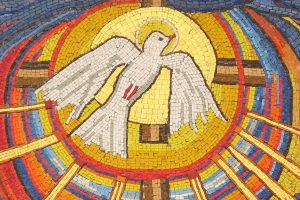
- We believe in the Holy Spirit, the Lord, the giver of life, who proceeds from the Father and the Son. With the Father and the Son he is worshiped and glorified. He has spoken through the Prophets.
But how was the process of divinization to occur in the lives of sinful human beings once Jesus had ascended into heaven? The Cappadocian Fathers-Basil the Great (died 379), Gregory of Nazianzus (d. 389), and Gregory of Nyssa (d. 395)-addressed themselves to this vexing question. They began by pondering how the Spirit-the Paraclete, whom Christ had promised and bestowed-might be said to be distinct from the Father and the Son. It was fortunate that these Easterners developed theological expertise in the matter, for Emperor Theodosius did not bother to invite the pope, or many other Western bishops, to the Council of Constantinople, which officially decided the question in 381.
Arians and their sympathizers at Nicaea, having denied the full divinity of Jesus, had also consigned his Spirit to the status of a mere creature, one whose glory was on loan from on high. The Holy Spirit's stock naturally rose, however, as the Athanasian defense of Christ's divinity gradually won broad support from theologians and bishops. Saint Basil shrewdly imitated Athanasius' successful strategy of deriving orthodoxy-or right belief-from orthodox prayers-or right worship-and took as his proof-text the fourth-century liturgical doxology that ran, "Glory to the Father with the Son and with the Holy Spirit." One could not worship the Spirit with the Father, he maintained, unless the Spirit were "one in Being with" the Father.
Through the intervention of such friends in high places, the Holy Spirit was admitted into the club of fully divine persons, now a Holy Trinity. In a spirit of pragmatic compromise with his fellow bishops of the East, Basil agreed, however, not to include the controversial term homoousion in the doctrinal definition. Today, as a result, we do not verbalize our belief that the Spirit, too, is "one in Being" with the Father. The intent of the Council of Constantinople was nevertheless received unambiguously by the church: The Holy Spirit is the third person of the Trinity, of the same substance as the Father and the Son.
The Holy Spirit was not to escape a fair share of controversy, however. The Creed elaborated at Constantinople held that the Spirit proceeds from the Father; this was the Cappadocians' clever, if hairsplitting, answer to the pressing question: Within the Godhead, how is the Spirit different from the Son? Answer: In the Trinity, the Son is begotten of, or generated by, the Father, while the Spirit proceeds from the Father.
But theologians, being the inveterate troublemakers they are, could not leave well enough alone. The careful reader, or attentive reciter, will notice that the Creed familiar to Roman Catholics includes the line "who proceeds from the Father and the Son" in reference to the procession of the Holy Spirit. By this one phrase, rendered in Latin by the word filioque, what remained of the unity of Christendom by the High Middle Ages was sundered in the year 1054, when the patriarchs of the East traded insults and excommunications with the bishops and pope of the West.
The Great Schism was irretrievably widened when Rome, acting solely on its own authority and without consulting the Eastern sees, added the filioque to the Creed. Perplexed and aggrieved Eastern Christians, citing scripture (John 15:26, where Jesus describes the Spirit as proceeding "from the Father") and the first four ecumenical councils, howled that this egregious departure from conciliar tradition would have the effect of subordinating the Spirit to both the Son and the Father, and thereby threaten a return to the ancient heresies. Already unable to give conscientious assent to an exalted doctrine of papal primacy, the Byzantine churches greeted the filioque as the proverbial last straw. Thus, in an unintended and highly ironic consequence, the Holy Spirit, who had unified the discordant voices at Pentecost, became the occasion for a painful divorce in the 11th century.
- We believe in one holy catholic and apostolic Church. We acknowledge one baptism for the forgiveness of sins. We look for the resurrection of the dead, and the life of the world to come. Amen.
The doctrines about the church follow directly from the affirmations about God as Creator, Word, and Spirit. They confess belief, that is, in a God who is present to the Christian community in and through nature, graced humanity, and divine inspiration.
As with every article of faith, the church had its doubters. The Donatists of the fourth century, for example, scandalized by the faithlessness of Catholics who had committed apostasy by the hundreds of thousands during the Roman persecutions, insisted that the church be purified of its unclean elements. Egregious sinners might be rebaptized into the church, the Donatists allowed, but only after a long and severe penance undertaken outside its spiritual protections.
Such a policy, Saint Augustine retorted, would lead either to the wholesale evacuation of the churches or, worse, to a kind of moral rigorism and puritanism by which church officials would presume to discern exactly where the City of Man ends and the City of God begins-a task better left to the Eternal Judge. In addition, Augustine argued, the purity of the church and the validity of its sacraments was not to be measured by the presence within it of accomplished sinners. It had always contained multitudes of them. And yet, through its life of prayer and through the testimony of its holy martyrs, saints, bishops, and, yes, theologians, however imperfect their comprehension of the one Christ, the church had retained the marks of unity, holiness, catholicity, and fidelity to the teaching of the apostles.
Almost 1,600 years after Augustine defended the doctrine of the church, it continues to inspire doubt, even and perhaps especially among its spiritual daughters and sons. They regret and repent the occasions, such as the Great Schisms of the 11th and 16th centuries, or the innumerable lesser schisms of the 20th, when Catholics have seemed to stray from the unity and holiness of the apostolic faith as it has been lived, proclaimed, and painstakingly defined since the age of the apostles.
And that is why, Father Bob, the Creed is so important to us. We need a constant reminder of who we were, and who we are called to be.


Add comment