

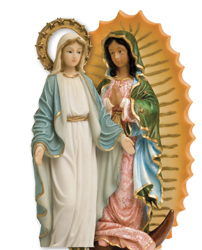
They're not immigrants, but they don't feel fully "American" either: U.S.-born Latinos are struggling to find their place in the U.S. Catholic Church.
As a former Catholic who had given up his faith, Aurelio Manuel Montemayor could not understand why he was weeping at the sight of the Virgin of Guadalupe. He wasn't seeing a vision. The bilingual educator with a master's degree was watching television at his home in San Antonio, Texas, tuned to the Spanish-language station that carried the weekly Mass from the historic San Fernando Cathedral. On this December day about 15 years ago, the church service was celebrating the Guadalupe feast day, which marks the 16th-century apparition of an indigenous, copper-skinned Mother Mary to a poor Aztec peasant at the start of the Spanish conquest of Mexico.
The Mass, complete with Mexican mariachis, reminded Montemayor of his days growing up in the border town of Laredo during the 1950s, an era of booming growth for Catholicism. He was the adopted son of a Mexican American couple who worshiped at Our Lady of Guadalupe Church, where his mother was the organist and where he served as an altar boy. As a boy, Montemayor recalls, that he became "probably more Catholic than my parents."
Even after moving away from home and becoming a high school teacher, he remained "a real Bible-thumping Catholic for a while," teaching Bible study at night and serving as a padrino at Baptisms by day. But all that changed in the 1970s when Montemayor took up the banner of the Chicano movement, the political and cultural uprising that swept the barrios of the Southwest.

"The institution I aimed my first tirades at was the Catholic Church," he says. At meetings, marches, and in manifestos, he lashed out against what he considered the church's "institutionalized support for peonage."
By the time he found himself crying while watching that Guadalupe Mass, he had long stopped confronting the church. It was now the mid-'90s and he was no longer angry. He just didn't care. He had lost his faith and was drifting.
So why the tears?
"It kind of caught me off guard," remembers Montemayor, 64, who now works for a nonprofit dedicated to improving public schools. "There was obviously still a very strong attachment, but it's funny because in my mind I said, ‘Well, I don't believe in this any more.' It's a deep fond memory. It brings up emotions, but my emotions are not the center of who I am. Old habits die hard."
Wanted: Gente puente
The rocky religious journey of Montemayor, who now practices Buddhist meditation, represents a critical challenge for the Catholic Church in 21st-century America-how to keep itself relevant for the U.S.-born offspring of Latino immigrants as they merge successfully into mainstream U.S. society.
Unlike their immigrant parents, who have been the almost exclusive focus of Hispanic ministry for the past quarter century, these second- and third-generation Latinos speak English, have college degrees, buy homes in the suburbs, and get jobs as professionals.
They are hyphenated Americans who have blended into society to a large degree but who retain a deep-seated connection to their cultural roots and a visceral attachment to a Latino way of worshiping.
Reaching-and retaining-these successful, assimilated Latinos is considered a priority for the church in the coming century. At stake, some say, is nothing less than the future of the Catholic Church in the United States.
Meeting that challenge will require breaking with the old assumptions, political paradigms, and pastoral practices that helped the church serve previous generations of immigrants.
Instead, it will require a multi-faceted, local approach that defies a single national plan. Many parishes have made attempts-youth groups, networking among professionals, special youth retreats called "Chicano Search." So far, though, these efforts have been scattered and results spotty.
When faced with the great influx of immigrants flooding U.S. parishes over the past three decades, the church responded by recruiting Latino priests and ministering to the newcomers in their language. Serving subsequent generations will also require a special recruitment, observers agree, but not one based on language or ethnicity.
The key to serving this Latino American population lies largely in identifying and developing what experts call gente puente, or "bridge people." They can be clergy or lay, Latino or Anglo, young or old. The only requirement is that they be comfortable with dual cultural identities and allow this growing number of bicultural Catholics to be as American or as Latino as they need to be.
"To some extent, it's a new challenge for us," says Bishop Jaime Soto, a U.S.-born Latino recently named coadjutor bishop of the Diocese of Sacramento (who is interviewed on pages 18-22). "There are many of my generation, going back to the '50s and '60s, who feel that the church at that time did not always respond to them or include them. Many of them, if they didn't leave the church or just leave religion altogether, just kind of stayed at the margins of their parishes.
"It's an issue for us now because they are there and they want to exercise leadership in the church. But they want to do that in a way that allows them to express their culture and their own religious values."
Latino spirituality
Part of the problem is that second- and third-generation Latino Catholics are too dispersed to address as distinct congregations concentrated in specific geographic areas. So the solution is more subtle and elusive than simply starting Spanish Masses.
Sometimes even Latinos themselves have trouble expressing the causes of their disaffection, partly because success has required them to suppress the cultural manifestations of their faith.
Yet some see hope in the fact that these cultural forces keep tugging at the souls of Latino Catholics, even those who leave the church. The trick is to find a way to tap into those strong cultural roots before they leave.
Many Latino Catholics, for example, cling to the sacramental and devotional rituals they grew up with, no matter how assimilated they become. Their Catholicism still relies on the symbols, customs, and traditions of their past, which, if not acknowledged or respected, can make them feel alien in their church.
"Their way of being Catholic doesn't completely go away," says Jesuit Father Allan Figueroa Deck, a Mexican American recently appointed director of the new Office for Cultural Diversity in the Church at the U.S. Conference of Catholic Bishops. "That persistence tells you that they are holding onto something."
Statistics show that among U.S.-born Latino Catholics there is a developing disparity between the church's membership and its leadership.
In the United States today half of all Catholic children under age 10 are Hispanic. Yet Hispanics account for just 1 percent of U.S.-born priests, according to statistics from the Instituto Fe y Vida, a research and advocacy group based in Stockton, California. That gap is alarming, even taking into account the church-wide priest shortage, which has resulted in one priest for every 1,375 parishioners. Among U.S.-born Latinos, the priest-parishioner ratio is one for every 27,000.
If the trend continues and those Hispanic children enter adulthood without entering the priesthood, the church hierarchy will become more and more unlike its flock. Already, for the first time in history, more U.S. Latino Catholics were born in the United States than in a foreign country.
"This is the future of the Catholic Church, and there is no way to walk away from it," says Deck. "We're going to have to target English-speaking Hispanic ministry."
Unmelted
For the past quarter century, the church's Hispanic ministry has concentrated almost exclusively on the burgeoning population of immigrants that has flowed across the border and filled barrio parishes from Santa Ana, California to San Antonio, Texas and most recently cities of the Southeast, the region with the fastest growing Latino population in the country.
Through an array of pastoral approaches-instituting Spanish Masses, fostering devotion to Guadalupe, developing youth groups, encouraging popular religious rituals like the Posadas or the Day of the Dead-the Catholic Church has not only welcomed this growing congregation but has helped make aspects of Latino culture more familiar and accepted within U.S. society at large.
To meet the challenge, the church was able to fall back on a well-rehearsed game plan from the past. To serve previous waves of Irish, Italian, Polish, and German migration, the church created national parishes organized around language and ethnicity, a sort of separate-but-equal pastoral segregation that respected the distinct cultural and spiritual practices of individual communities.
Now the demographic sands are shifting. The children of hard-working, marginalized, often oppressed Latino immigrants are growing up in a different world with a vastly transformed set of circumstances. Many have dissolved into the proverbial American melting pot, assimilating just as Irish and Italian Americans did before them.
But it would be a serious mistake, warn many Latino church leaders, to assume that the paradigm of assimilation that worked with European immigrants in the 19th century applies to the children of Latino immigrants today. Conditions and attitudes are radically different, and so is the cultural hold of the old country on second- and third-generation Latino Catholics.
Globalization, instant communication, increased mobility, speedier transportation, more tolerance for multiculturalism, all of these conditions affect how-and how far-Latinos will assimilate in the 21st century. And that process will shape the church's future.
In the 1950s the church tried to move away from the national parish, worried that it slowed the integration of immigrants into American society. New York's Cardinal Francis Joseph Spellman spelled out a new policy of quick integration and a new role for the church as a mediator in that process. But it was a pastoral reversal that had unintended consequences.
"If you tell people, as the church used to, that you have to become good Americans, well, the good Americans are WASPs (White Anglo-Saxon Protestants) and they go to Ivy League schools and they're secular and they're Episcopalians," says Anthony Stevens-Arroyo, professor emeritus of Puerto Rican and Latino Studies at Brooklyn College. "So if you tell people to become more American, then they stop being Catholic. Now the church has caught itself and said, ‘Wait a minute! We didn't mean it that way.'"
Bilingual and bicultural
Unlike previous generations of immigrants, Latinos hold onto a cultural Catholicism rooted in their ethnicity, their family loyalties, and their national origins. It's the reason they cry for Guadalupe even after they stop practicing their faith and why they eat both tamales and turkey at Christmas.
To understand the new dynamic, says Stevens-Arroyo, consider the way corporations market to young Latinos. Advertisers don't assume that they will lose their identity or even to some extent their language. But they don't make the mistake of thinking they can reach them through strategies used on their parents, with ads on Spanish-language television or radio.
In fact, U.S.-born Latinos have developed their own bilingual culture that is both distinct from the American mainstream and from their nations of origin. These Latino Catholics inhabit the limbo of a bicultural world-too Americanized to identify totally with their roots, yet still too Latino to abandon them.
Often they do not feel fully accepted by either group, creating what Mexican American theologian Father Virgilio Elizondo has called "the pain of having no proper space or community of one's own."
But there are new possibilities born of this displacement, argues Elizondo, professor of pastoral and Hispanic theology at the University of Notre Dame. They are the same centuries-old possibilities created by mestizaje, the fusion of race and culture symbolized by the appearance of Guadalupe.
"The ones that are born of this displacement can begin to claim and affirm both of the traditions," Elizondo told the National Catholic Reporter in 1996. "In a way what appears to be a curse becomes a blessing."
Just as the union of Aztecs and Europeans created a new culture in Latin America five centuries ago, the great melding of Latinos into U.S. society marks a new beginning, he says, one that "will be celebrated in new religious rituals and rites" combining both cultures. In the process, concluded Elizondo, "we begin to create a common space where all can belong."
Faith-to-faith migration
Although the secular media has played up the defection of Hispanic Catholics to evangelical churches, the major loss of Latino faithful during that decade was not to another religion but to no religion at all.
Between 1990 and 2001, the number of Hispanic adults who declared no religion increased from 6 percent to 13 percent, according to a report issued in 2002 by the Program for the Analysis of Religion Among Latinos/as (PARAL).
Sylvia Puente was one of those Latino Catholics who had renounced religion-until a blessed event changed her life. Puente, a fourth-generation Mexican American, was raised in an ethnically diverse Chicago suburb, where her parents were active in their church and helped start its first Spanish-language Mass. She went to Catholic schools and church every Sunday.
But Puente became disillusioned when she came up against the rigid roles defined for women in the church, and she rebelled. "I wasn't going to be that kind of a woman," says Puente, 49, who holds a master's in public policy from the University of Chicago. "How could I be in a place where women weren't fully respected?"
For years Puente did not practice any religion and even questioned the existence of God but could not bring herself to consider a different faith. "The thought of exploring other faith traditions felt like a mortal sin," she says. Then her daughter Veronica was born.
"I struggled with whether or not I should have her baptized," recalls Puente. "I thought, ‘I'm not going to church. I really don't have a lot of faith in this church.' But how could I not baptize her?"
Puente decided to go ahead with the sacrament, though she never intended to raise her daughter as a Catholic. Her decision was based on what she calls "a deep-seated organic spirituality."
"It was still so embedded, as much as I thought I had rejected it, I still had to baptize my daughter," Puente recalls. Eventually she joined a congregation of the Kansas-based Unity Church, which she describes as a non-traditional denomination. Puente also explored the indigenous side of her spirituality, going on retreat to New Mexico where she worked with Mexican and Lakota spiritualists, learning rituals she still practices today.
Puente now works for Notre Dame's Institute for Latino Studies, directing the Chicago office, and occasionally attends Mass, "depending on the priest." For her daughter, however, the issue of religion remains unresolved. Now 20, Veronica is part of the trend-another young, U.S.-born Hispanic, fifth generation, who identifies with no specific religion.
One size does not fit all
Reaching this cohort of Latinos-geographically dispersed and culturally split-won't be easy. The key, some say, is realizing that there is no single answer any longer. A pastoral plan for the next generation of Latinos must be as diverse as the people themselves.
Explains University of Notre Dame theologian Timothy Matovina: "You can't say, ‘Alright, for third-generation Latinos who don't speak Spanish anymore but who want to be connected to their culture, you do A, B, C, and Latinos will be fine.' No, you need a method of listening and of community-building, a method that understands the complex interrelation between culture and faith."
That's a tall order for a church strapped for cash and priests. To get the job done, new lay leaders will be needed with the ability to cut across all the old dividing lines-between residents and new arrivals, English-speaking and Spanish-speaking, Anglo and Latino. And almost everyone agrees the church must focus on youth.
"Youth ministry is a critical piece," says Ken Johnson-Mondragón, a former youth minister in Santa Cruz, California. "If we don't do a good job, that's where we're going to lose them."
Only 10 percent of youth ministers today are Hispanic. The overwhelming majority are white, middle-class, and college-educated who acknowledge a major weakness in "working with kids of a different culture," says Johnson-Mondragón, director of the Research and Resource Center for Hispanic Youth and Young Adult Ministry at Instituto Fe y Vida. This socially polarized situation discourages Latino teens from participating, often despite urging from their parents, because they "just don't feel like they fit in," he says.
Enter the gente puente.
"Those are the kids who excel," says Johnson-Mondragón. "They are going to become leaders in the church and in society. By identifying these gente puente, we can give a sense of hope and direction for the teenagers."
Yet the bridge people don't have to be Latino.
"There are a lot of Anglo priests who speak Spanish and do incredible work with Latino Catholics," notes Matovina of Notre Dame. "Sometimes in my experience they are better prepared to help a young Latino in transition who wants to feel accepted. The Anglo guy can say, ‘You're one of us and you can still be as Latino as you want to be.' That can be more attractive to the transitional Latino than a Spanish-speaking priest recruited from [a Latin American country] who's sort of saying, ‘Ay, Chihuahua, what's the matter with you? You forgot your language. You're losing your culture; you're going to lose the faith.'"
One way of breaking down cultural barriers among young Catholics, says Johnson-Mondragón, is to organize youth groups not around ethnicity but around interests. So instead of a single youth group, there would be several, for those who like sports, choir, or who simply want to gather for prayer.
Reconnecting
Frank Ornelas, 44, did not originally see himself as one of those bridge people. He's Mexican American but didn't speak Spanish growing up in Southgate, a blue-collar Latino suburb of Los Angeles. He dropped out of the University of California in Irvine, an upscale Orange County community, because he felt he didn't fit in with either the dominant Anglo culture or the activist Latinos on campus.
By then, he had lost his Catholic faith. From the time he was 18 until almost 30, he turned his back on religion. "The church and faith and Jesus, I wouldn't even say they were secondary in my life," says Ornelas, who chokes back tears at the memory. He didn't find his way back to the church until he had an awakening at a Marriage Encounter with his wife.
Ornelas, a father of two young daughters who now lives in Irvine, was recalling his spiritual journey in a small garden behind St. Thomas More Church, a multi-ethnic parish. As the gusty Santa Ana winds tousled the rose bushes, he recounted how his reconnection with his faith led him to connect with his culture like never before.
Earlier this year a fellow parishioner nominated Ornelas to serve on the steering committee of a new Hispanic group in the parish. At first he wanted nothing to do with them because he thought they would split the congregation along ethnic lines. Besides, his parents did not raise him with Mexican religious traditions.
After prayer and reflection, Ornelas decided to join. He says the Lord had told him, "Check it out. You might bring something to the table that might help some people." Now, despite his language limitations, he teaches religious education to recent immigrants.
In November Ornelas prepared an altar for his late father as part of the Day of the Dead observance at his church. It was the first time in his life he had ever participated in the Mexican tradition, which was open to the entire congregation.
"Historically I don't have that cultural tie," he says. "But I also started to realize that the church is universal. So why not open this altar to the congregation? It doesn't have to be Hispanic." "It's not about the culture anymore," he adds. "It's about the faith."



Add comment