

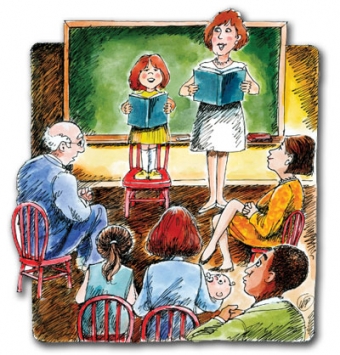
Religious education is not just for kids anymore as more parishes are including the entire family. Even Grandpa's invited. Shortly before Christmas last year, Rachel Squier, 11, of Streetsboro, Ohio announced to her parents that she thought the family should "go visit some poor people."
While Rachel's parents were pleased that their daughter was showing concern for those less fortunate, they knew a discussion was in order.
"We sat down as a family to talk about Rachel's idea," Rick Squier says. "My wife and I tried to help her understand that you couldn't just knock on someone's door and say, ‘I notice that you're poor,' and visit them."
As they listened to Rachel, Rick and Natasha realized that the genesis of their daughter's interest in the poor was a program at their parish called Generations of Faith. The theme for the year was social justice, and Rachel, having learned about her responsibility to reach out to those in need, was intent on doing just that. Rachel and her family eventually decided that she would knit hats and make lunches for the homeless, and they'd bring them to a shelter.

"It was a proud moment for me as a parent to let Rachel lead our family like that," Squier says. "She answered the call she felt. I have to believe that she's going to be a more helpful person down the line because of it."
Sister Gay Rowzie, H.M., director of faith formation at the Squiers' parish, St. Joan of Arc, says Rachel's experience of Generations of Faith is an example of what the program's end goal is-helping people better live their faith beyond the walls of the church.
"Generations of Faith has given life to our whole parish," she says. "It has flavored everything we do."
Not just for kids
Generations of Faith is one of several programs that use a new approach to faith formation that differs considerably from a traditional children's religious education program. In a typical religious education program, parents drop children off once a week for an hour-long class with other children in the same grade. The new programs are intergenerational and involve the entire family, both children and parents. In some parishes adults of all ages who do not have young children attend as well.
In the Generations of Faith program, each year has a theme-sacraments, social justice, traditions in the church-and each month tackles a different aspect of that theme. Sessions are typically offered once a month on several different days, and are two to three hours long.
While parishes differ in their approaches to the sessions, many begin with Mass and a meal, followed by a large group activity, and then time to break out into smaller groups for discussion. Often groups are divided by age. The session then ends with the re-gathering of the group for a brief prayer or closing song.
While traditional religious education is still the norm in most parishes, intergenerational programs of faith formation, also known as "whole community catechesis," are growing in popularity. Their supporters believe that the programs are much stronger than traditional religious education and that eventually most parishes will move toward a version of it.
Like traditional programs intergenerational religious education requires that for children to receive sacraments, the family must attend the program the year before as well as the year of the sacrament. While intergenerational programs do not usually require textbooks, as traditional programs do, Harcourt Religion Publishers and the Center for Ministry Development in Naugatuck, Connecticut have developed products based on an intergenerational approach to faith formation.
A hard sell
St. Joan of Arc is in its third year of Generations of Faith, which replaced their traditional religious education program.
"There was some hesitancy on the part of parents at first," Rowzie says. "Parents were concerned that their children were not going to be in class every week, and they thought they would prefer just dropping their kids off to attending with them."
As Generations of Faith unfolded, however, and parents began to experience sessions, they embraced it whole-heartedly, Rowzie says.
"One key for us is that we get excellent speakers-experts in their field who also have something to say about their personal faith journey. For most people, religious formation stops when they are out of school. Here parents continue faith formation as adults. Children see that learning about faith is a lifelong process," she says.
Rick Squier agrees. He says that he was initially skeptical about the time commitment of the program, noting that dropping his daughter at religious education was convenient for the family. As he and his wife became involved, though, they noticed a benefit they had not anticipated-time to learn and talk about meaningful subjects.
"It's great to be able to discuss something besides home and work," Squier says. "The topics change, but a lot of the discussion is about how you make the topic relevant to family life. I think our marriage has become stronger because of Generations of Faith. It's led us to spend time talking about something that's as deep as you can get-your soul and your spirituality."
Squier added that attending the program has allowed him and his wife to be more tuned in to what their daughter is learning.
"I think it's important that both the children and parents learn something that's age appropriate," he says. "Everyone is learning at their own level, but on a similar topic. We understand more about what Rachel is learning, and we can talk to her about it."
St. Roman Parish in Milwaukee calls its intergenerational program Festivals of Faith. More than 400 families gather the first weekend of each month for either the 4:30 Saturday evening Mass or the 9:30 Sunday morning Mass and have a meal followed by a two-hour session.
Michelle Zakula, co-director of lifelong faith formation at the parish, says that when the parish switched to Festivals of Faith from their traditional religious education program three years ago, the staff knew that some families would leave their program.
Research indicates that the year a parish moves from a traditional religious education program to whole-community catechesis, there is a 10-percent drop in the number of children participating.
Some of these families eventually return if the program has good reviews from other families, and often new families join through word of mouth. At St. Roman, there was a 7-percent drop in enrollment the first year.
"We looked at whole-family catechesis and decided it was the best we could offer our families, and that we had a responsibility to offer the best," Zakula says. "So we did, and at the same time we prepared for a huge fallout. When we announced the change, I thought parents would riot-but other than a little grumbling, we didn't have much resistance. And once people experienced the program, they loved it."
Mass attendance has gone up since the inception of the program, and the parish has a much stronger community feel, Zakula says.
"These are people who never would have met without Festivals of Faith," she says. "Sometimes I watch the people as they pitch in to help clean up after a program, and they're talking and laughing, and I cannot even believe we've been blessed with this."
Group projects
St. Roman bases Festivals of Faith on a program created specifically for monthly intergenerational faith formation. Zakula also ties topics to the Catechism of the Catholic Church as well as documents from the bishops and gives families work to do at home.
A recent assignment for families for the month that focused on Baptism was to craft a family white garment. On the garment the family put baptismal memorabilia such as a bit of lace from Grandma's baptismal gown, photos from children's Baptisms, written memories of how the family celebrated. Each family then processed in with their garment to begin the next session.
Zakula says the biggest challenge of her program is that if a family is away for a weekend, they have no way of making up a session.
"We post our materials on our website, so they can do some of the work at home, but there's no way to make up the community involvement of a session," she says.
Other parishes deal with this by offering the same session multiple days a month, rather than only one weekend.
Zakula says that another hurdle was helping catechists, who were used to a traditional weekly classroom format, to become comfortable with the new approach.
"Our catechists struggled with this," Zakula says. "They were fearful of the loss of class time."
When the catechists examined the program, however, and looked at both the content that was covered each year as well as the benefit to the children of having parents so actively engaged, they agreed that the model would work well for their parish.
"The catechists knew that they would miss being such a large part of children's faith formation," Zakula says. "Yet, as we discussed, we came to the understanding that the relationship we were most interested in was not the relationship between the teachers and the students but the students' relationship with Christ. And we knew that would best be fostered throughout the child's life, in the family."
While the program is family-based, Zakula is quick to point out that parents are never put on the spot in terms of teaching their children during the session itself.
"We make sure the parents' faith knowledge is not put under a microscope," she says. "We are educating parents as well, and once the parents have the educational background they need, it will be easier for them to receive and absorb what their children are learning."
Mix and match
Some parishes combine intergenerational with traditional programs in their religious education. Children and youth still attend classes in their grade level once a week, but in addition, these parishes schedule special events that involve the parents.
East Side Child and Youth Ministries (ESCYM), a cluster of parishes on the east side of Milwaukee, for example, holds "family nights" every month or two. Families gather with a potluck supper and then participate in a family project that reflects the season or a particular gospel.
After exploring the meaning of All Souls Day, they made Jacob's Ladders with pictures of loved ones who had died. They have made Valentine's cards for the meal program that one of their parishes runs and have written "love letters from God" to their families.
A family reconciliation service is celebrated every Lent, and each December the classes do skits, presentations, or songs for their family Christmas program.
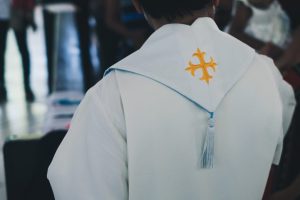
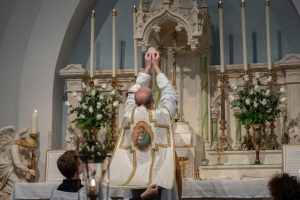
ESCYM also holds a "Teaching Mass" every other year. One of their pastors vests before the families, identifying each vestment. As he celebrates Mass, he explains what he's doing and why and some of the history behind certain practices and traditions in the Mass.
In Verona, Wisconsin, a small town outside of Madison, St. Andrew and St. William Catholic Communities are in their fourth year of Generations of Faith. Unlike many parishes that focus on parents with school-aged children only, this parish designed the program for parishioners of all ages. Participants are between the ages of 5 and 95.
In their monthly meetings, which are offered on three different days of the first week of the month, participants may be divided by age, but they also may be in mixed-age groups, or groups that are all male and all female. In addition, children attend traditional religious education classes once or twice a month, depending on their age.
Deb Schroeder, the director of youth ministry for the parish, attributes the program's success to the cohesiveness of the parish staff-from the pastor to the maintenance person to the music minister. She says that the staff views Generations of Faith not as a program but as the way to pass on the faith.
"It's not just another option, or a burden we put on families," Schroeder says.
In a recent session in their year studying "What is church?" Schroeder set up learning stations around the church to teach about the significance of objects often associated with the Catholic Church. Small mixed-aged groups walked around the church hearing short talks about such things as stained glass, bells, the rosary, holy oil, incense, and statues of saints. When Schroeder planned the day, she knew it would be valuable to the children who had limited knowledge of the church, but after the session she was surprised by the reaction of the senior generation.
"The older people just loved it," she says. "It brought them back to their childhood. Another woman told me that it made the Holy Thursday Mass much more meaningful to her because she had never understood before the significance of the oil that is part of the opening procession."
Labor of love
The nature of intergenerational faith formation, with its long, in-depth sessions, requires those directing the program to be ready to work hard. Those running the programs agree that they are more difficult to manage than traditional religious education, and that they have a greater chance of failing if the parish is not fully behind them as the primary method of faith formation.
"I believe Generations of Faith takes more talent on the part of the staff," Rowzie says. "It requires a team of people to be cooperative and in dialogue. It's much more collaborative than a traditional program."
Michelle Zakula says she would caution a parish against running the program as an option while continuing to offer traditional religious education. While St. Roman tried that for a couple of years, Zakula observed that families didn't enter fully into Generations of Faith until it was the only option. In the meantime, the staff was wearing themselves out running two full programs. Now, with just one program to focus on, Zakula says she still has more than enough to do.
"I host 300 people for dinner and a presentation each month," she says. "It's like planning a wedding every month. It's exhausting, but it's exciting and worth it."
Image: William Petersen



Add comment