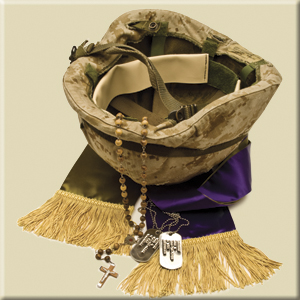
 The U.S. armed forces are looking for a few good men-priests-to serve Catholics in uniform. But some question whether Father should rank among military officers.
For much of the previous year, Father Joe Porpiglia had a grueling routine-and he wasn’t even running his parish in Buffalo. He was in Afghanistan as a U.S. chaplain, racing across a rugged and war-torn landscape in massive helicopters and transport planes. He served Mass and the sacraments to thousands of soldiers, but also offered counsel and comfort to anyone who sought him out.
What makes Porpiglia’s tour stand out is that he was one of only 10 Catholic chaplains in Afghanistan during the last 18 months.
That hardly meets the needs of the huge population of Catholics serving in the U.S. military. According to CatholicMil.org, a website for chaplains and military personnel, out of 1.2 million active-duty soldiers, 375,000 are Catholic. And don’t forget to add their 800,000 dependents. Yet just 300 priests are currently ministering to them. During World War II there were 3,200 Catholic chaplains, accounting for 1 out of every 10 U.S. priests at the time.
Today’s numbers have triggered the Pentagon to aggressively recruit Catholic priests to serve as chaplains. The campaign includes advertising in Catholic publications, including U.S. Catholic.
High-level officers speak with bishops and visit seminaries with the message that the U.S. Army alone needs 400 priests. In 2007 the Air Force invited thousands of priests to spend several days at Peterson and Schriever Air Force Bases in Colorado and fly in military aircraft. Six priests ended up joining the Air Force Reserve, and 11 became active duty.
Still, serving as a chaplain is a grueling job, taken on by men and women often much older than their physically fit soldiers. Nobody denies the need for military chaplains, but both chaplains themselves and other Catholics debate how they can serve God and the army at the same time.
Capt. Father Gregory Caiazzo is a recruitment officer and spokesperson for the U.S. Navy’s Chief of Chaplains Office, which oversees all chaplains for the Navy, Marines, and Coast Guard. He says some Catholic priests have been deployed multiple times. “It is really inspiring to see the [priests] that do it over and over again,” he says.
One of those priests is Porpiglia. The lieutenant commander has been a reservist with the Coast Guard for 17 years and recently returned home from his second tour, which was extended several weeks. Six years ago he took part in the beginning of the Iraq War.
His most challenging missions involved moving from one forward operating base (FOB) to another so he could celebrate Mass and hear Confessions. Some of these FOBs are small outposts where there’s no running water or kitchen; others are huge complexes complete with gyms and a Pizza Hut.
“I don’t like focusing on me,” he wrote recently from an air-hub while waiting for a plane back to his home base in Kandahar, Afghanistan. “I like to focus on what our men and women are doing and the great job they are doing.”
Nevertheless, Porpiglia, who is physically unassuming, quips, “Did I tell you the flak jacket with plates weighs 70 pounds?”
Faith at the front
Father Marian Gardocki has also donned the flak jacket in 120 degrees of stifling Afghan heat-weapons free, as all chaplains do. In May of last year he went out on a patrol searching for Taliban. It is not something he likes to do, but it’s not easy turning down your fellow soldiers who ask, “Padre, come with us on patrol, because we will be safe then.”
Gardocki is pushing 60, yet he’s still in the Navy reserve, trains with Marines on weekends in Baltimore, and works during the week as a counselor at the VA medical center in Buffalo.
Looking back on two tours, the last in 2008 in Afghanistan, Gardocki is most satisfied that he had become to the troops a shield of sorts from the demons of a war zone, a source of energy, and a confidant.
“Most of the soldiers are so very young,” he says. “When they come to me, they tell me they miss home. They tell me they are scared to die. They are just 18, 19 years old. And it is their first deployment. Their first experience away from home.”
Deeply philosophical answers to a soldier’s questions of death aren’t suited for the battlefield, says Gardocki.
“I tell them, you have to open your eyes. Listen to your staff sergeant and follow orders. Take the orders seriously and you will be safe. Follow orders and don’t ignore anything.”
Perhaps his most vivid experience with the troops occurred in May 2008, in a sparse and isolated province called Farah, near the Iranian border in western Afghanistan. Early one morning intelligence identified Taliban not far from the base. Marines were dispatched to set up an ambush.
A few hours later, radios began to crackle with action-medivacs with injured Marines were coming in.
Even before the helicopters could be heard, anxiety began to spread, hearts began to pound. Gardocki had been here before-in Iraq. “I was very familiar” with dealing with the injured, he says. He began telling anyone he could to “calm down, do your job.”
Seven wounded Marines were soon rushed into emergency rooms.
“The surgeon told me to come quick,” Gardocki says. “He said to me, ‘I have to do my job, now you have to do yours.’ He wanted me to pray [near the Marines]. I went where he was doing the surgery and prayed. For three hours.”
The day ended better than expected. The Marines were stabilized and transfered to better facilities. All survived. Many at the base told Gardocki that his presence had helped all involved make it through.
“I was happy to be able to serve these people, to enrich their lives, and bring them the sacraments.”
Trouble on the home front
The U.S. military’s recruitment of priests has not gone unnoticed by civilian Catholics. Several Catholic publications, including U.S. Catholic, have heard from a significant number of readers complaining about the military’s advertisements for chaplains.
Some have questioned whether Catholic clergy should be participating in war, period. Others have criticized the number of tax-payer dollars spent on recruiting priests when many dioceses nationwide are shuttering parishes due to their own lack of clergy.
Caiazzo of the Navy’s Chief of Chaplains Office, who served on the USS America aircraft carrier during the first Gulf War, bristled when told some Catholics don’t want Catholic publications to advertise for something they don’t believe in. He’s surprised some Catholics have misgivings about priests serving troops.
“U.S. service members deserve the best we can give them,” he says. “They need as much spiritual care as medical care. We’re not toting guns-we’re ministering to the People of God.”
Catholic chaplains, he says, believe in the same principles as the warriors they serve: protecting freedom, standing up for the underdog, and fending off those who have nothing to offer but oppression and violence, the same principles the Catholic Church has always embraced, he says.
But not all share Caiazzo’s view that the church and the U.S. military share the same principles. Indeed, Pope John Paul II said the invasion of Iraq did not meet the criteria of a just war, and U.S. bishops made similiar statements. This rift raises complex questions for chaplains and the church.
How do Catholic chaplains do their job while acknowledging the enormous moral complications of serving in a war that has been condemned by their own church? What’s more, how do they model a loving, merciful God in a combat theater in the first place?
Father John Barkemeyer, a chaplain with the U.S. Army who is preparing for his third deployment, left his Chicago parish in 2003 to serve U.S. troops as they invaded Iraq. It was a war he didn’t believe in, yet he heeded the call because he knew there was a need. And he partially agrees with Caiazzo: “We largely share the same values of the soldiers we serve, but it is much more than that.
“We need to be able to link our beliefs that life is a sacred gift from God, and, [that] sometimes, rarely, war is a moral necessity,” says Barkemeyer, 45. “Our service men and women are focused on accomplishing the mission, whatever mission they are given. We need to view the military mission in light of our faith and be able to translate what this means to those we serve.”
When their own church condemns the war they are fighting, Catholic troops “face a terrible paradox,” says Barkemeyer.
“They try to hold onto a faith that says God is good and loving while they are surrounded by evil, suffering, extreme violence, and death,” he says. “One thing I started doing was at every Mass I would include in the Prayers of the Faithful a prayer for our enemies.
“By praying for our enemies and explaining why we do it, I hope that all of us are transformed. I hope we are moved beyond our grief, anger, and suspicion to put our work in a war zone into a wider context, that we are all children of God and that our lives cannot be ruled by hate.
“I tell my troops if you can follow the command of Christ to ‘love your enemies and pray for your persecutors,’ you are real Christians.”
Serving in a war that the church has condemned is not an issue for Barkemeyer.
“For me as a Catholic priest and chaplain in the U.S. Army, my mission is to serve soldiers,” he says. “The moral question of ‘should we be fighting this particular war’ isn’t at the heart of what I do. Soldiers don’t get to pick and choose the wars they fight in; politicians do.
“I do end up teaching the just-war tradition to soldiers, and we have powerful discussions about which criteria seem to apply. [But] my job is not to convince soldiers of any particular position but to explain our faith and help them digest the implications.”
Divided loyalties?
The debate over how Catholic priests should serve the troops is not a new one. Tom Cornell, a deacon from Marlboro, New York, was one of the first draft-resisters of the Vietnam War to publicly burn his draft card and defy a war he did not believe in. He ended up serving six months in prison for his crime. Forty years later he finds himself again promoting peace the best way he can.
The anti-war activist is a veteran of the Catholic Worker movement and co-founder of the Catholic Peace Fellowship, which supports conscientious objectors through education and advocacy.
Cornell is not surprised about the U.S. military’s immediate need for priests. If you include their dependents, he says, the numbers of those in the U.S. military dealing with poverty, post-deployment disorders, and substance abuse is tremendous.
“They need Catholic priests. I am not against this,” says Cornell, who mentions he lives in a state hit hard by its own priest shortage. He believes in absolute pacifism, but allows that a military force could be used for police action if absolutely necessary to protect the innocent.
What Catholic Peace Fellowship promotes is that priests should serve the military but not join as chaplains who automatically are awarded officer status when they finish training. Cornell wishes priests could serve simply as civilians, trained and paid for by the Catholic Church.
He says chaplains are trained to treat conscientious objectors with “good will.” But he believes many priests-turned-officers are “socialized” to discourage any conscientious objector who seeks their counsel. He says the Catholic Peace Fellowship in recent years has documented evidence showing priests have turned their backs on soldiers wishing to object.
Observant Catholics, if they believe a war to be unjust, are encouraged to object, as stipulated by the Second Vatican Council, says Cornell.
“Without being inducted into the officer corps, they are free of any kind of dual loyalty,” he says. “When he is inducted, [a priest] is torn between two loyalties: the gospel and the moral code of the officer corps, which looks upon conscientious objection as undermining the morale of the other men.”
Judy McCloskey, director of CatholicMil.org, says, “It would be a logistical nightmare to [change] Catholic chaplaincy to civilian priests only.”
She believes the U.S. military would not allow any civilian priest military clearance, thus denying sacraments to those on the front lines. The U.S. chaplaincy would become “Protestantized,” she says, considering a majority of U.S. chaplains are already Protestant. And for a priest to minister to troops, he needs the proper training.
“Which untrained civilian priest is going to minister to military personnel in Qatar, Kuwait, Afghanistan, or Iraq-or the next military hot spots?” she asks. “Military personnel in general will find the priest less approachable if he’s not wearing a uniform, especially if Catholics are singled out while every other denomination in the chaplain corps is in uniform.”
“There’s a lot more to being a chaplain than just counseling and guidance,” says Father David Daigle, a U.S. Navy lieutenant colonel who blogs for CatholicMil.org. “Religious ministers will not and cannot be replaced by a psych corps or guidance corps or whatever. I’m here to take care of people who otherwise won’t be taken care of or receive help with irregular marriages, and being confirmed, receiving First Holy Communion, Confessions. So, there is a definite and huge need for priests in the military.”
“Take care of my men”
Debates aside, there can be no doubt that soldiers value the ministry of their priest-chaplains, especially because that service can come at a terrible cost.
Lt. Col. Father Timothy Vakoc died on June 20, 2009, five years after becoming the first severely injured Catholic chaplain since Vietnam. He was 49.
On May 29, 2004, Vakoc was unexpectedly ordered back to his base at Mosul in Iraq. Injured troops needed his attention. But on the way a bomb tore into his Humvee. Vakoc suffered a severe traumatic brain injury from the blast. Multiple lobes of his brain were damaged.
Earlier this year, defense department doctors estimated that 45,000 to 90,000 troops have suffered brain injuries. Many will never come close to being who they were before the war.
Indeed, the struggle back for Vakoc was more harrowing than the attack itself. Several different life-threatening bacterial infections had him in and out of comas for months at a time. A kidney stone caused more pain. But he fought on, inspiring many with his resiliency. A website documenting his progress has been visited more than 250,000 times. Thousands have left messages.
“Father Tim-I think about you often,” wrote Dawn Shook, who served in 2004. “We were so shocked and upset when your convoy was attacked. Who can make reason out of so much hatred? I pray for those who attack us as well. I loved attending your Sunday Mass and hearing your weekly ‘lessons.’ They helped maintain a sense of normalcy in so much sadness and chaos.”
Anita Brand, Vakoc’s sister, says parish work was never for him. He didn’t care for arguing over the decorations for Mass. He lived for one thing.
“That was his first priority in life-serving his soldiers,” she says. “He loved caring for them.”
Brand says he would, when on base, sit on the steps at the commissary, read a book, and wait for his troops. “He would minister on the steps,” she says. After the attack he ministered from his bed.
Before he died, Vakoc said he counseled and helped “many thousands of troops.” Leaving the robes behind for the forest greens and desert hues of the U.S. military’s camouflage uniforms was an easy decision. “I wanted to do God’s will, and if it is in the line of fire that’s where I’ll be,” he said.
When asked to reflect on the war that wounded him, he said it is “important.” “I’d do it again in a heartbeat.” He wanted to tell Washington the troops need “more support”-both “spiritually and financially.”
His sister, Brand, has spoken to several soldiers and others who were near her brother as he was brought to the base in Mosul following the attack. There was pressure on his brain, and they had to induce him into a coma. “Before he went under-and I have heard this from several guys,” she says, “he told another chaplain who was also there, ‘Take care of my men.’ ”
This article appeared in the November 2009 issue of U.S. Catholic magazine.