

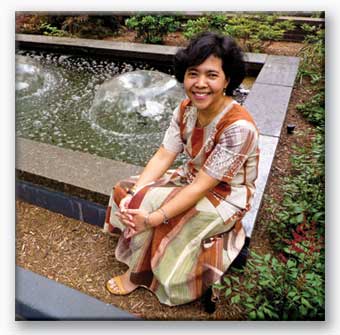
There’s much in Islam that favors women, says this scholar. As sisters in faith Muslim and Catholic women can seek out such traditions together.
The editors interview Syafa Almirzanah
What is it like to be a Muslim woman in the United States?
I don't think there's a big difference being a Muslim woman in the United States or in other countries. Muslim identity for me is about how we act, not a veil.
Why do you choose not to wear a veil?
The way I understand "veil" is not indicative of clothing but is part of an attitude: I have to be very humble and not sexually attractive to other people. Veiling does not mean that you must put on certain clothing but that you must watch your behavior.
How do other Muslims view the veil?
People in the United States think using a veil is backward and oppressive. That's not always true. Some women feel they have to wear a veil because it is part of their beliefs, and some are just comfortable wearing it.

There are different interpretations of what the veil means. The veil can refer to segregation in history, for example. Even if Muslims refer to the veil as clothing, there's a lot that's still debatable: What kind of clothing makes men more attracted to you? I have a friend who always used a veil but she would wear clothing that didn't go down to her feet. I would say to her, "So which one is more attractive: your hair or your calves?"
The biggest concern is that women will be forced to wear a veil. There is no compulsion in religion, the Qur'an says. But right now more traditional Muslims want to force every woman to cover herself from head to toe.
There are two verses about the veil. The first one is specific to the Prophet's wives, and it doesn't specify the type of veil. Whether it refers to clothing or separation from other men is open for interpretation.
The other verse says that Muslim women also should be humble and cover up until just below the bosom. Some scholars say that this verse refers to breastfeeding a baby because in pre-Islamic tradition women used to feed babies in front of everyone.
What other misconceptions do Westerns have about Islam?
Since September 11 the media has portrayed Muslims as violent. We cannot condemn the general public who understand Islam this way because they see only what the media is showing, and the violence is real. People say that Islam is the most misunderstood religion. This isn't just the fault of western media. Muslims also contribute to the violent portrayal of Islam.
Those of us who are educated in Islam know that the teachings of Islam don't support violence. Still, after September 11 even a friend condemned my faith. My response was, "You are a minister and you are an intellectual. You should know that Islam is not a monolithic religion. If a Christian man robbed a bank and I said all Christians are robbers, it would not be true."
Your son attended public schools in the United States. How did he get along with his classmates?
He had no problem. He really loved his school and made a lot of friends and I think that's because of the customs in my home. I always taught him to respect other people, even if they have different points of view.
In first grade in Indonesia he came home from his school one day and asked, "Mom, is it true that only we will go to paradise?" His teacher told him that. I said, "Sweetie, your responsibility is to do what your religion asks and do good things for other people. Going to paradise is not your business, and it is not your teacher's business either. That's God's business."
My son became friends with my academic adviser, who is a priest. A Buddhist monk also used to come to my home. In Indonesia every religion has TV programs, and he used to watch these. Maybe more traditionalist Muslim parents would forbid children from watching other religions' programs, but not me.
Family is where children learn, so it's important to teach respect for other religions at home.
What have you learned through interfaith dialogue?
There is a story from the Sufi Rumi about a shepherd and Moses. Moses saw the shepherd praying, "God, please show your face to me so I can bring you a meal." Moses got mad that the shepherd imagined God as human, so he said, "Hey, shepherd, you are not the son of infidel; your grandfather and father are Muslims. Why do you pray like that?" The shepherd was ashamed, but then God spoke: "Moses, your responsibility is to bring other people to me, not refuse people who already come to me. It doesn't matter how they pray. The most important thing is that their hearts are burning for me."
I think that's an important story. What happens in my country, for example, is that people try to speak for God. That's idolatry. I say that we have to speak about God without speaking for God.
Related: U.S. Catholic’s full interview with Syafa Almirzanah from January 2009.





Add comment