

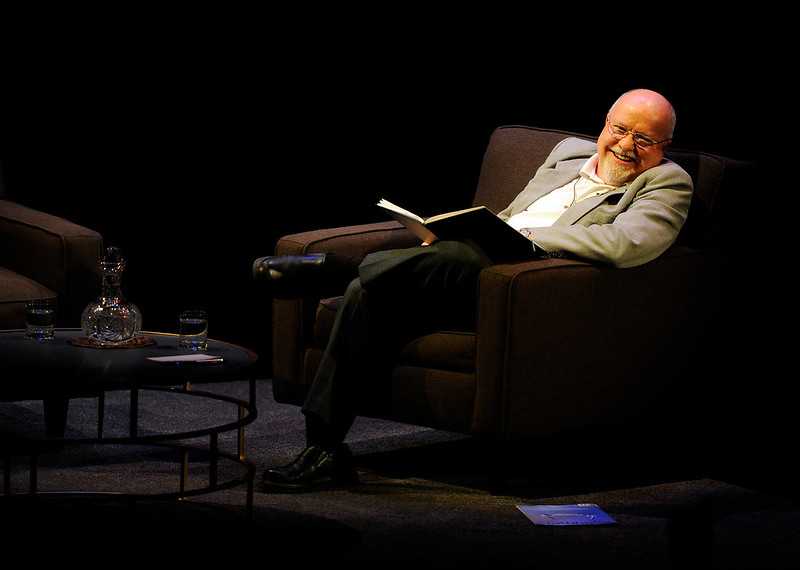
As he’s entered middle age, Franciscan Father Richard Rohr, who has been riding the spirituality circuit for more than 30 years, has started to think about life in halves: the first dedicated to establishing boundaries and a sense of self in one’s own group, the second to opening oneself to a more universal vision of the world.
Rohr is quick to point out, though, that you’ve got to have the first before you pass into the second. “We need to begin ‘conservative’ with clear boundaries, identity, a sense of ‘chosenness,’ ” he writes in his newsletter Radical Grace. “Then as we grow older, we should move toward more compassionate, tolerant, and forgiving worldviews.”
Rohr’s own first and second halves have been full and busy. In his first half he founded the charismatic New Jerusalem Community in Cincinnati in 1971 and the Center for Action and Contemplation in Albuquerque, New Mexico in 1986. Today, though still a popular speaker and author, Rohr spends more time alone, living in a hermitage behind his community.
Rohr became a Franciscan friar in 1961 and was ordained a priest in 1970. He is a prolific writer and popular speaker on male spirituality, scripture, prayer, and other topics, and is the founding director of the Center for Action and Contemplation. His most recent book is Adam’s Return: The Five Promises of Male Initiation (Crossroad, 2004).

You’ve said that spirituality is different in the two halves of life. What do you mean by that?
In a nutshell the task in the first half of life is the development of identity and boundaries. One must develop a necessary concern for the self: “Am I special? Am I chosen? Am I beloved?” Unfortunately it often takes the form of “Am I right?” leading to either/or thinking.
This accounts for much of our contemporary confusion, it seems to me. The first half of life is concerned with the container; the second with the contents. But most people become preoccupied with the container.
Can you give an example of a first-half-of-life person?
Let’s look at a typical military school cadet. Who would not admire him? His pants are creased; his hair is cut; he’s clean; he’s polite; he’s on time; he loves God and country. If I need to hire an employee, give me a West Point cadet. He’ll do what he’s told. Great stuff, but don’t for a second call it the gospel.
But, unfortunately, for many of us, that’s what it means to be a Christian, and that not only misses the point, it openly obstructs it. Remember what Jesus said: “Your virtue must surpass the virtue of the scribes and Pharisees.” It’s a virtue of sorts but not yet what he is talking about.
A mere concern for order, purity, identity, self-esteem, and self-image is necessary to get you started. You have to have an ego to let go of your ego. You have to have a self to die to yourself, but the creation of a positive self-image is not the issue of the gospel. Quite the contrary. That’s probably why Jesus did not start teaching until he was 30 and seems to have almost exclusively taught adults.
Once you teach something like “love your enemies,” you’re not talking about tit-for-tat morality anymore. That kind of thinking is not understandable to people still involved in the tasks of the first stage of life. In fact, it appears dangerous and heretical to them.
How does someone move from the first half of life to the second?
The two stages are not primarily chronological, although they can be affected by chronology.
Normally there has to be a precipitating event that leads to transformation. I call it the “stumbling stone,” using a biblical term. Your two-plus-two world has to fail you, has to fall apart. Business as usual doesn’t work. Usually that involves something very personal: suffering or failure or humiliation.
The boy or girl who just dances from success to success will easily stay in the first half of life forever. I think that’s what Jesus means by saying that it’s harder for a rich man to enter the reign of God than for a camel to pass through the eye of a needle. It’s a strong statement.
Thomas Merton wrote about new monks coming in and said he thought that since the Second World War American parents had tried to keep their children from any negative experiences. He recommended that monasteries not accept anyone who had not gone through a spiritual crisis. He argues that they weren’t ready for religious life. In fact, he thought the monastery’s job might be to facilitate a spiritual crisis for many of the monks.
If you are lucky, God will lead you to a situation you cannot control, you cannot fix, or you cannot even understand. At that point true spirituality begins. Up to that point is all just preparation.
Does suffering always lead to the second half of life?
Not always. Sometimes it just leads you to circle the wagons of your own little group. It depends on whether you deal with your suffering in secular space or sacred space.
The secular response to suffering is to fix it, control it, understand it, look for someone to blame. You learn nothing. Unless suffering pulls you into sacred space, it doesn’t transform you. It makes you bitter.
In sacred space, if you can somehow see God in it, suffering can lead you to the universal experience of human suffering, even identification with the suffering of God. At that point, you’re moving into the second half of life. The questions are now more mystical than merely moral.
Are you in danger of idealizing suffering?
Yes. But I’m not saying go out and search for it. Suffering is inevitable, and if you can be convinced that it is a teachable moment and not something to run from, you’re doing yourself a great favor.
There are really only two paths to transformation: prayer and suffering. But because few of us just walk into a wonderful journey of surrendered prayer, you can really say there is only one path, which is suffering.
That’s why Jesus talks about the Way of the Cross so much. Until your nice, coherent interpretation of reality has been beaten up a bit, why would you let go of it? Some form of suffering is the only thing strong enough to destabilize the ego, in my opinion.
What specific experiences can cause this to happen?
Loss of a job can be a big one, especially if you’re very invested in your work. Death, of course, is the biggest of all, especially the death of someone close or an unjust death. A major humiliation is another way. I know a lot of priests who have come to God through being accused—rightly or wrongly—of sexual abuse. The public persona isn’t there anymore, so who am I now?
Moral failure is a common biblical pattern that leads to the second half of life, as we see very clearly in both Peter and Paul. Somewhere along the way my own moral failures have the power to get me to finally fall into the mercy of a loving God. If I lied to that person or I used that woman, I have to ask myself, “What kind of person am I that I did that?”
I think this is what Paul meant when he said that the law was given to us to induce failure (Rom. 7:7–13). We try to make the law an end in itself. But it is only the necessary starting place, an impossible goal of perfect love to force us to rely upon God.
I’m not encouraging sin, but I recognize that it’s going to happen anyway, so you better learn from it and listen to it a bit, instead of thinking, as religious people love to do, “I’m above that.”
What characterizes the second half of life?
The second half of life is love, joy, peace, and the Holy Spirit. You’ve experienced the death of the need to be right, to think well of yourself, to think you’re superior to and more moral than other people. It’s a tremendous peace. You don’t have anything to prove anymore. You don’t have to live up to or to live down to your reputation, you just are who you are. You have met the enemy and the only enemy is you, not any other group, religion, nation, or race.
People in the second half of life are not rebels. If you’re a rebel, you’re still trapped in the first half. That’s not wisdom yet. At the wisdom stage, you don’t need to rebel or hate or oppose.
I do think only a small percentage of people get there. Some get there in the last two or three years of life. But why not start this enjoyment and freedom when you’re in your 40s, 50s, and 60s?
Can you actually help people move from one stage to another?
Not easily. And we cannot do it to ourselves either. We can only trust the Holy Spirit to lead us there. This is why Jesus taught what he would have called the sign of Jonah: going into the belly of the beast, into darkness. From that place God will spit you up on the right shore.
Once you learn to trust the redemptive pattern, the dying and rising of everything, you don’t need to be on top all the time. Once you realize the Paschal Mystery as the redemptive process, I think you naturally pass out of the first half of life.
Jesus modeled it all for us in a dramatic way, so once and for all we could see the pattern and believe it. Unfortunately we just keep thanking him for doing it instead of recognizing that he said, “Follow me.”
So Jesus was trying to move people into the second half of life?
It seems that Jesus saw much of his work as getting people to see the insufficiency of mere ritual practice and tribal belonging. The majority of Jesus’ teachings and healings make a hero of the non-Jew, the nonobservant person. He discredits any affiliation as a substitute for real transformation.
We still cling to that: I’m a Catholic. I’m an American. When we haven’t really been transformed, we try to ride on the coattails of our group. That becomes our self-image and our identity.
I think Jesus is trying to precipitate the fall, the disappointment, by pulling away all idealistic badges and loyalty systems so we have to find our identity in God, not in groups.
Jesus also made discipleship an invitation, not a requirement. It’s an invitation to a transformed life, which allows you to live in the reign of God now.
You’ve said that we did a good job of helping Catholic children in the 1950s in the first half of life. What happened after that?
There is much criticism about the form of religious education we used in the 1970s and 1980s, and for good reason. If you reject a good container, you eventually reject the contents, too.
Because the older generation had the first half of life shoved down our throats, we reacted against it. So then we didn’t teach children how to say the Hail Mary and what the feast days are, all of which solidify your sense of specialness inside this Catholic universe.
But we were so aware of how many people had fallen in love with the container and never got to the contents. “Church-ianity” is a very common substitute for Christianity, and I think it’s on the rise again. It always seems to happen in insecure times.
Still, every generation has to walk the whole journey for itself.
So you absolutely need the first half of life, right? What if you don’t get it?
Yes, you absolutely need it. If you don’t get it when you’re young, it’s a big problem. You end up needing rigid rules and superiority systems in your 30s and 40s, which is precisely why fundamentalist religion is growing.
I was a jail chaplain in Albuquerque for 14 years, and these young men who wasted their youth on drugs, sex, and rock and roll were invariably very black and white in their thinking.
The young liberals of the 1960s who jumped directly to the supposed second half of life, thinking they didn’t need the first, are almost always a disaster.
So how should parents who didn’t get good first-half-of-life Catholic education pass the faith along to their kids?
We need to give children the experience that there’s something good and rich about being Catholic. Once you know that, you don’t need to know that your faith is better than all the others. It’s only the self-centered ego that is preoccupied with the question, “Are we right?” The soul doesn’t need to know the answer to that. The soul just asks: “Is this real? Is this good? Is this true?”
Kids need to see something that their parents are “juiced” about, are energized about. You can’t fake it. Kids need energy, and they like positive energy.
An example: My niece and her husband each take time out for an hour of eucharistic adoration at their parish in Kansas every week. I’m convinced that this single act is what has made their four kids say, “Boy, there is something good and deep and worthy about Catholicism.” Just that one single action.
Can first- and second-half people find common ground?
For me, a litmus test for whether people are in the second half of life is whether they can be compassionate and patient with people in the first half of life. That’s proof that you’re there.
But first-half people will either be enchanted, attracted, and lured by people in the second half—which is the pattern in a healthy culture—or they will put up huge roadblocks against them, which is what’s happening in our country, both in the church and in the culture. To the person addicted to the container for its own sake, people who are into the contents will often look dangerous, heretical, sinful, and unorthodox—just as Jesus did.
Who are some people who are or have been in the second half of life?
Archbishop Oscar Romero of El Salvador is a good example. He was clearly a first-half person when he became archbishop, but the suffering of the Salvadoran people was transformative for him. He incurred the judgment of many of his fellow bishops and was very much alone by the end of his life.
I think Cardinal Joseph Bernardin moved into the second half right on schedule. In Cincinnati he was the boy who had gone from promotion to promotion, but his heart was humble and open. I saw that personally. I think clearly by his later years in Chicago, he was a second-half-of-life person. But it wasn’t the false accusation of sexual misconduct or even his illness—it was happening before that because he was teachable and honest.
I am convinced that Jesus’ famous line that “the truth will set you free” was not referring to some kind of dogmatic truth, but would probably be better translated as “honesty will set you free.” Absolute honesty will lead you to the second half of life.
I meet a rather large percentage of religious women who are clearly in the second half of life. They seem to walk a tightrope between loyalty to the church, the tradition, the poor, issues of justice, and their own inner experience. They hold together a very big picture.
Many people seem to gravitate toward Eastern religious practices these days. Does that have anything to do with movement from one half of life to the other?
I think there is a fascination, especially in the last 50 years, with Eastern religions because they are more open to both/and thinking. Their ability to describe the contemplative mind in today’s language is more developed than ours. Our Western consciousness is just moving there.
Some people will hear that as “relativism.” That’s not what I’m saying at all, but people in the first half of life will hear it that way, and you can’t do much about that. Much of what Jesus said would be called relativistic by honest readers of the gospel, but that is the way second-half-of-life people appear to you when you have not done your inner work.
If you know where you stand, precisely that knowing, going deep in one place, opens you up to a universal place. Every spiritual teacher knows that the point is to get to the universal, to get to the truth of the God who’s everywhere, what Jesus called “the reign of God.”
To do that you have to go deep in one place. You have to surrender to the God before you, the God image you fall in love with and allow to be your teacher and leader, and to whom you surrender. When that journey has happened, you’ll be able to see the goodness and sweetness in all people.
Image: Flickr cc via Festival of Faiths





Add comment